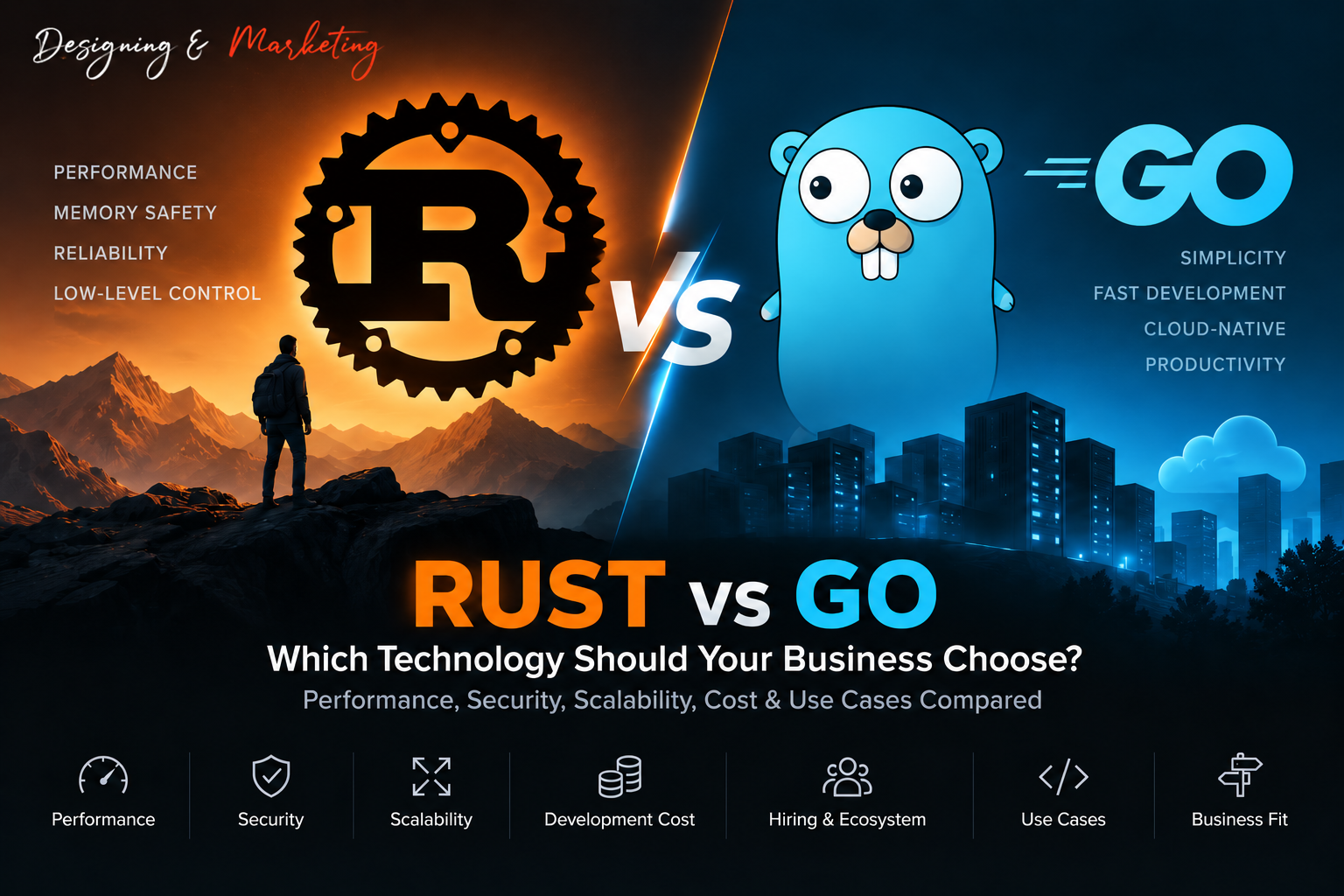
Choosing between Rust and Go is not just a programming decision. It can affect development cost, launch timeline, performance, security, infrastructure requirements, hiring and long-term maintenance.
This guide compares Rust and Go from a business and software-development perspective so you can understand where each language fits—and when another technology may be a better choice.
Rust vs Go: Quick Answer
Choose Rust when maximum performance, memory safety, predictable resource usage and low-level control are critical.
Choose Go when simplicity, faster development, backend productivity, cloud services and easier team onboarding are more important.
The right choice depends on what you are building. A simple SaaS backend and a performance-critical system should not automatically use the same technology stack.
Rust vs Go at a Glance
| Factor | Rust | Go |
|---|---|---|
| Performance | Excellent | Very Good |
| Development Speed | Usually Slower | Usually Faster |
| Learning Curve | Higher | Lower |
| Memory Safety | Strong compile-time guarantees | Managed memory with garbage collection |
| Cloud & Backend | Strong | Excellent |
| Systems Programming | Excellent | More limited |
| Concurrency | Powerful and explicit | Simple and productive |
| Hiring & Onboarding | More specialized | Generally easier |
| Resource Efficiency | Excellent | Good |
| Best Fit | Performance-critical software | Cloud, APIs, SaaS and backend systems |
Why This Decision Matters to Your Business
Business owners and product teams usually do not care which language looks better in a benchmark. They care about whether the product can launch on time, stay within budget, scale reliably and remain maintainable.
“Will we choose the wrong stack?”
Choosing technology without considering the product roadmap can create expensive migration or rewrite problems later.
“How much will development cost?”
The language affects hiring, development speed, debugging effort, infrastructure usage and long-term maintenance.
“Can we launch quickly?”
For many products, time-to-market matters more than squeezing out the last percentage of runtime performance.
“Will it scale later?”
Scalability depends on architecture, databases, caching, infrastructure and application design—not only language choice.
“Can we hire developers easily?”
A technically excellent language can still create business risk if experienced developers are difficult to hire or retain.
“Will maintenance become expensive?”
A maintainable system needs clear architecture, tooling, documentation and a stack your team can support over time.
What Is Rust?
Rust is a systems programming language designed around performance, memory safety and strong compile-time guarantees. It gives developers low-level control without relying on a garbage collector.
This makes it attractive for performance-sensitive systems, infrastructure, networking tools, security-sensitive components and software where resource efficiency matters.
What Is Go?
Go, also known as Golang, is designed for simplicity, fast compilation, concurrency and productive backend development.
It is a strong fit for cloud services, APIs, distributed systems, infrastructure tools and microservices because teams can often build and maintain Go services relatively quickly.
Rust vs Go Performance: Does Your Project Actually Need Maximum Speed?
Rust generally provides greater control over memory allocation and runtime behaviour. That makes it particularly strong when latency, throughput, resource usage or predictable performance are critical.
Go is also fast enough for a large range of backend and cloud workloads. For many business applications, database queries, network calls and architecture decisions may influence real-world performance more than the difference between the two languages.
Business takeaway: Do not choose Rust only because it can be faster. Choose it when that additional control and performance materially improves your product.
Rust vs Go Development Cost
Development cost is not determined by hourly developer rates alone. The complete cost can include development time, hiring difficulty, debugging, infrastructure, maintenance and future changes.
Rust Cost Considerations
- Higher learning curve
- More specialized development skills
- More upfront engineering effort in many projects
- Potential resource-efficiency benefits
- Strong safety guarantees can prevent classes of bugs
Go Cost Considerations
- Simpler language and onboarding
- Often faster backend development
- Good fit for larger engineering teams
- Mature cloud-native ecosystem
- Garbage collection simplifies memory management
For an MVP, SaaS backend or typical business API, faster implementation can make Go economically attractive. For performance-critical systems, Rust may justify greater upfront engineering investment.
Which Is Faster to Develop With: Rust or Go?
Go usually has an advantage in development speed because the language intentionally keeps many concepts simple. Developers can often become productive relatively quickly.
Rust requires developers to understand ownership, borrowing, lifetimes and more explicit memory-management concepts. This can increase the learning curve and initial development effort.
Go Is Often Attractive For
- REST APIs
- SaaS backends
- Microservices
- Cloud applications
- Internal tools
- MVP backend development
Rust Is Often Attractive For
- Performance-critical services
- Systems programming
- Networking software
- Security-sensitive components
- Developer infrastructure
- Resource-constrained systems
Rust vs Go for Security and Memory Safety
Rust's ownership and borrowing model is designed to prevent many memory-safety problems before the software runs. This can be valuable in systems where memory corruption or low-level bugs create significant risk.
Go uses garbage collection, removing many manual memory-management concerns. It can be a very safe and productive choice for backend systems, although it offers different guarantees and trade-offs compared with Rust.
Security still depends on much more than the language: application design, authentication, authorization, dependency management, data handling, infrastructure and secure development practices remain critical.
Rust vs Go for Scalability
Both languages can power scalable services. The more important question is how the complete system is designed.
Architecture
Service boundaries, asynchronous work, queues and system design can have a greater impact than language alone.
Data Layer
Database design, indexing, caching and data access patterns often determine whether systems scale efficiently.
Infrastructure
Containers, load balancing, autoscaling, monitoring and deployment strategy remain part of scalability planning.
A poorly designed Rust application will not automatically scale better than a well-designed Go application.
Rust vs Go by Software Use Case
| Use Case | Usually Better Fit | Why |
|---|---|---|
| SaaS Backend | Go | Fast development, simple services and strong backend/cloud ecosystem |
| REST APIs | Go | Productive tooling and straightforward concurrency |
| Microservices | Go | Simple deployment and cloud-native adoption |
| Cloud Services | Go | Strong ecosystem and operational simplicity |
| High-Performance Systems | Rust | Fine-grained control and excellent resource efficiency |
| Systems Programming | Rust | Low-level control with strong memory-safety guarantees |
| Security-Sensitive Components | Rust | Memory-safety model can reduce important classes of errors |
| DevOps / Infrastructure Tools | Depends | Go offers speed of development; Rust can offer performance and control |
| MVP Backend | Go | Often easier to build and iterate quickly |
| Resource-Constrained Services | Rust | Strong control over memory and runtime overhead |
Rust vs Go for SaaS Products
For many SaaS products, Go can be an attractive backend choice because development speed, maintainability and cloud deployment are often higher priorities than maximum low-level performance.
Rust may become the stronger choice when a SaaS product contains performance-critical services, large-scale data processing, networking components or infrastructure where resource efficiency creates a meaningful business advantage.
A mixed architecture is also possible. Businesses do not always need to use one programming language for every service.
Rust vs Go Hiring and Team Considerations
Technology selection should consider the team that will maintain the product over the next several years.
Go's simpler language design can make onboarding easier for experienced backend developers. Rust often requires deeper specialization, which can influence recruitment and training.
If the business already has a strong team in one ecosystem, moving to a new language should provide enough technical or commercial value to justify the additional learning and hiring cost.
When Should You Choose Rust?
- Your software has strict performance or latency requirements.
- Memory safety is a major technical requirement.
- You need low-level system or hardware control.
- Infrastructure efficiency has significant business value.
- You are building networking, systems or security-sensitive software.
- Your engineering team has the skills to maintain Rust effectively.
When Should You Choose Go?
- You need to build a backend or API quickly.
- You are developing cloud-native services or microservices.
- Simplicity and team productivity are high priorities.
- You expect multiple developers to maintain the system.
- You are building a SaaS platform or business backend.
- Maximum low-level performance is not the primary requirement.
When Should You Choose Neither Rust nor Go?
Rust and Go are strong technologies, but neither is automatically the right choice for every software project.
Depending on your requirements, technologies such as Laravel/PHP, JavaScript or TypeScript, Java, .NET, Python or another stack may offer a better balance of development speed, ecosystem, team expertise and cost.
Technology selection should start with the product requirements—not with a programming-language trend.
Should You Rewrite an Existing Backend in Rust or Go?
A rewrite should not be the first solution to every performance or scalability problem.
Before replacing an existing backend, review whether the real bottleneck comes from application code, database queries, infrastructure, architecture, external APIs or inefficient workflows.
A targeted rewrite of one performance-critical service can sometimes create more value than rebuilding the entire platform.
Not Sure Whether Rust or Go Is Right for Your Project?
The best technology choice depends on your product requirements, users, expected traffic, integrations, development timeline, budget, team and long-term roadmap.
Designing & Marketing IT Solutions helps businesses evaluate technology options before development begins. With 10+ years of experience across web, mobile, software and digital solutions, we can help plan an architecture and technology stack around the project instead of forcing the project around a trend.
Technology Consulting
Evaluate the right stack, architecture and implementation approach before development starts.
Custom Software Development
Build software around your workflows, product requirements and long-term growth needs.
Software Modernization
Review existing systems and identify where optimization, refactoring or selective rebuilding can create value.
Choose the Technology That Fits the Product
Planning a SaaS platform, backend system, API or custom software project? Talk to our team before committing to the technology stack.
Discuss Your Software ProjectFrequently Asked Questions About Rust vs Go
Is Rust better than Go?
Neither is universally better. Rust is often stronger for performance-critical and low-level systems, while Go is often a better fit for productive backend, cloud and microservice development.
Is Rust more expensive to develop than Go?
Rust can require more specialized expertise and greater upfront engineering effort, while Go can often reduce development and onboarding complexity. Actual project cost depends on scope, architecture and team.
Is Go better than Rust for SaaS development?
For many SaaS backends, Go can be attractive because of development speed, simplicity and cloud ecosystem. Rust may be preferable for performance-critical services within the platform.
Which is better for high-traffic applications, Rust or Go?
Both can support high-traffic applications. Rust offers stronger low-level performance control, while Go offers productive concurrency. Architecture, databases, caching and infrastructure are also major scalability factors.
Is Rust safer than Go?
Rust provides strong compile-time memory-safety guarantees. Go uses managed memory and garbage collection. Overall application security still depends on architecture, dependencies, authentication, authorization and secure development practices.
Can Rust and Go be used together?
Yes. A system can use different technologies for different services. Go may handle standard backend services while Rust is used for a performance-critical component.
Should I migrate my existing backend to Rust or Go?
Only after identifying the actual problem. Performance or scalability issues may come from databases, architecture, infrastructure or integrations rather than the programming language itself.
How do I choose the right backend technology for my business?
Evaluate product requirements, performance needs, development timeline, budget, existing team, integrations, expected scale, security needs and long-term maintenance before choosing a technology stack.