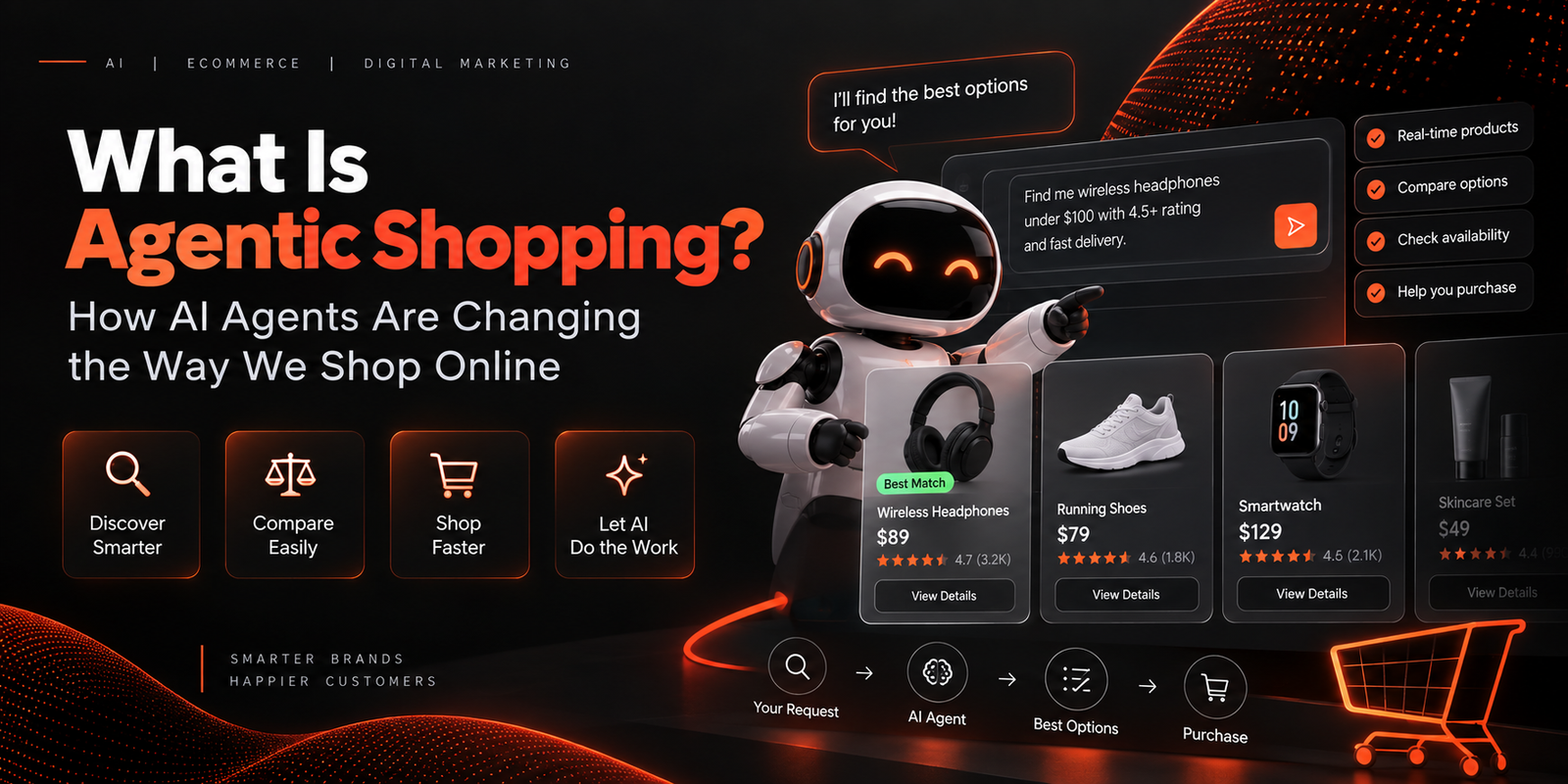
Online shopping has traditionally meant searching for products, opening multiple websites, comparing prices, reading reviews and finally making a purchase. Agentic shopping is beginning to compress that entire journey.
Instead of manually handling every step, shoppers can increasingly describe what they want to an AI agent and let the system research products, compare options, evaluate important details and help move the purchase toward checkout.
Quick answer: Agentic shopping is an online shopping experience where AI agents help consumers discover, compare, evaluate and potentially purchase products based on their goals, budget and preferences.
The major shift is that AI is moving from simply answering shopping questions to helping perform parts of the shopping process.
What Is Agentic Shopping?
Agentic shopping is an ecommerce experience in which AI agents can help users search for products, understand their requirements, compare alternatives and assist with purchasing decisions.
The key difference between agentic shopping and a traditional chatbot is action.
Traditional AI Assistant
Answers questions, summarizes products or suggests options, but usually leaves the shopper to complete the remaining steps manually.
Agentic Shopping Agent
Can interpret intent, gather product information, compare alternatives and assist with actions that move the customer closer to a purchase.
Simple definition: Agentic shopping turns AI from a tool that tells you what to buy into an assistant that can help you actually buy it.
How Does Agentic Shopping Work?
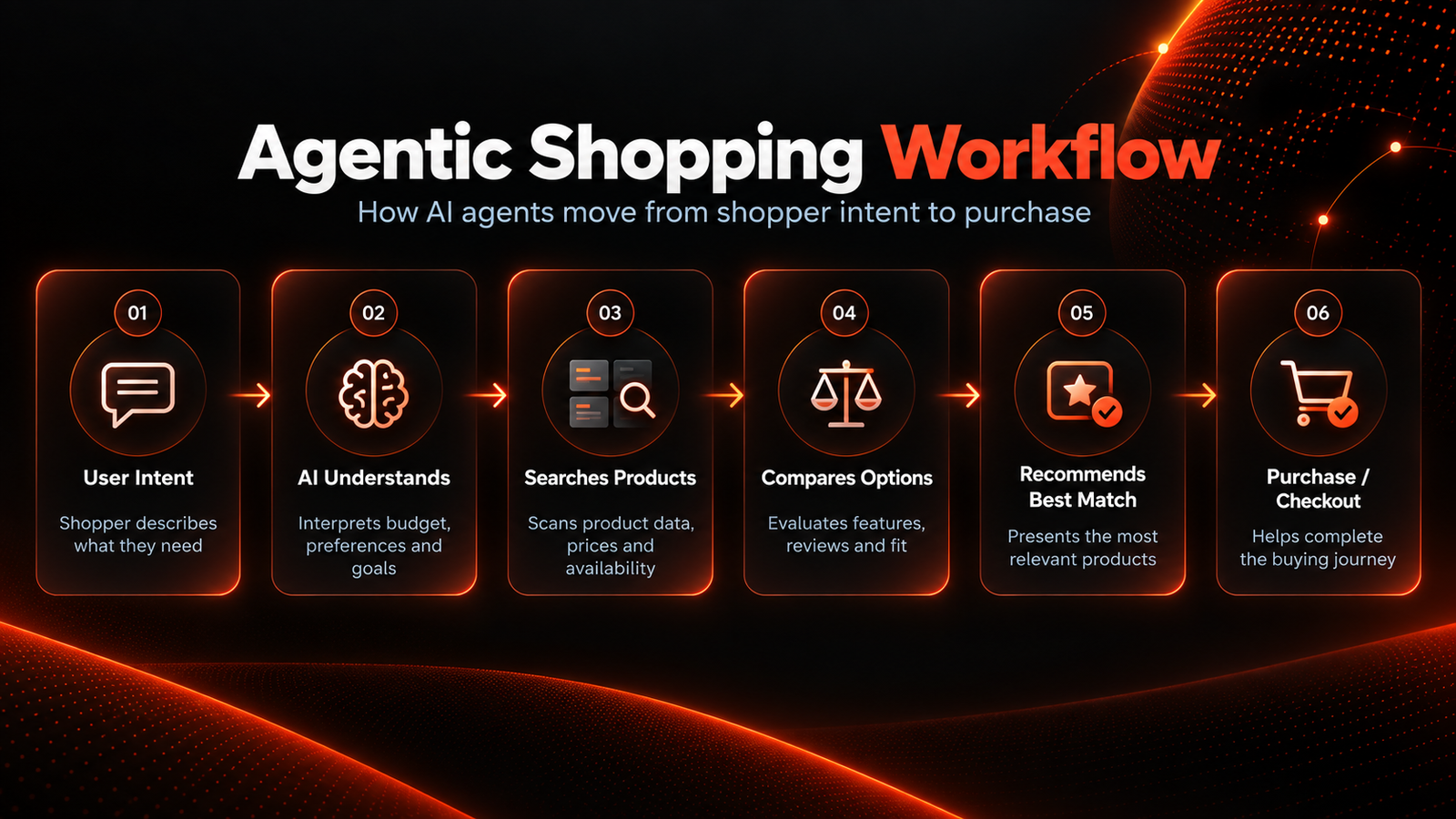
An agentic shopping journey typically begins with intent rather than a short keyword.
For example, instead of searching:
Traditional query: best laptop under $1,000
A shopper may ask an AI agent:
Agentic request: Find me a laptop under $1,000 with at least 16GB RAM, strong battery life, a lightweight design and enough performance for Photoshop and occasional video editing.
The AI system can interpret multiple requirements at once and then use available product information to narrow the options.
What Product Information Does an AI Shopping Agent Need?
For an AI agent to make useful recommendations, product information needs to be complete, accurate and easy for machines to interpret.
- Product category and description
- Price and current availability
- Sizes, colors and product variants
- Technical specifications
- Materials and dimensions
- Customer ratings and reviews
- Shipping information
- Return and refund policies
- Compatibility information
- Merchant and brand details
Agentic Shopping vs Traditional Ecommerce
Agentic shopping does not necessarily eliminate ecommerce websites. What changes is how users discover products and how much research they need to perform themselves.
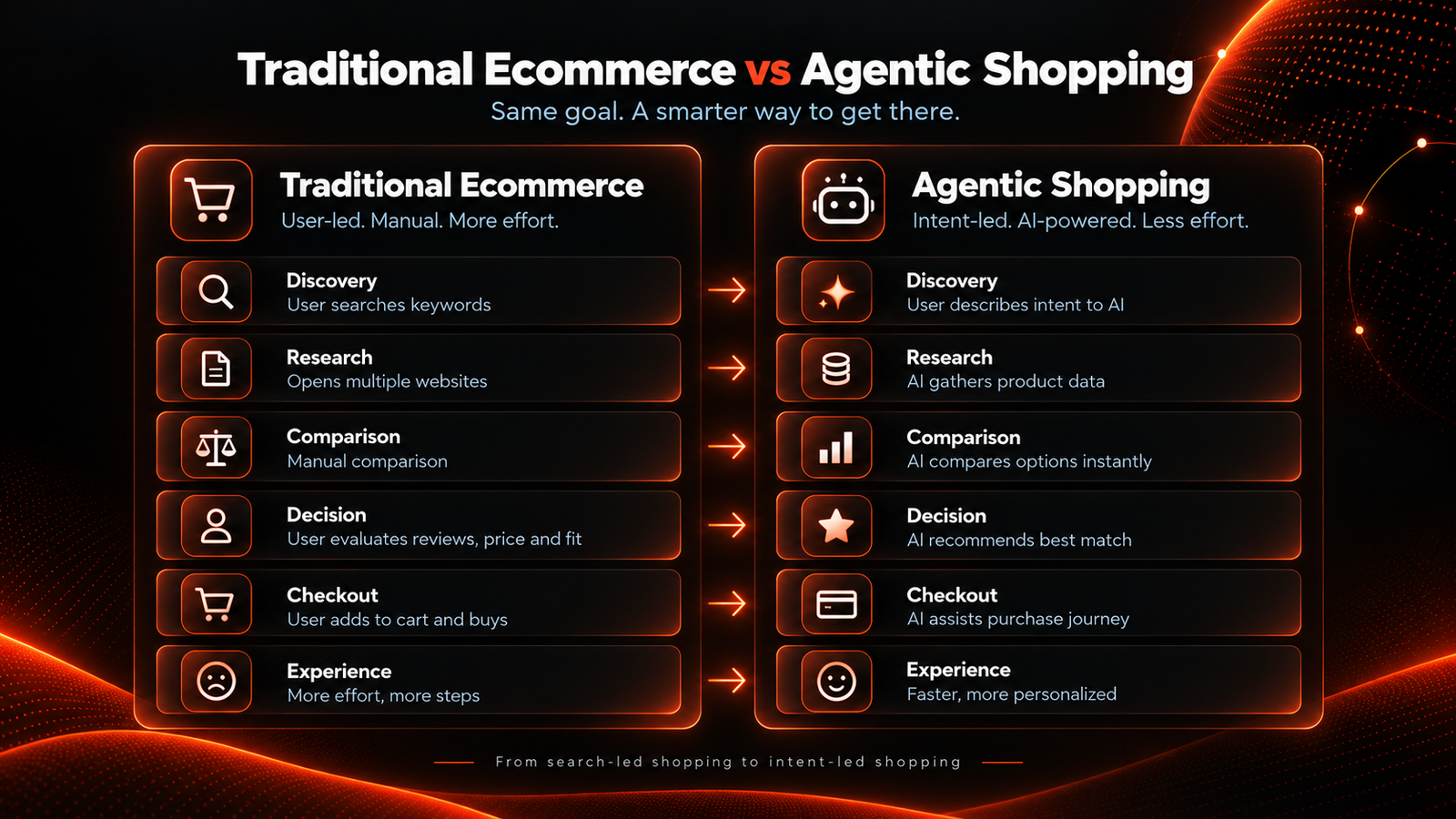
| Traditional Ecommerce | Agentic Shopping |
|---|---|
| Shopper searches keywords | Shopper describes an outcome or need |
| User opens multiple search results | AI gathers relevant product information |
| User manually compares products | AI compares products based on requirements |
| User reads multiple product pages | AI summarizes important differences |
| User checks price and availability | Agent can use current commerce data when available |
| User decides which product is suitable | AI can recommend the best-fitting options |
| User manually moves through checkout | AI may assist with parts of the purchase journey |
Traditional journey: Search → SERP → Website → Product → Comparison → Cart → Checkout
Agentic journey: Intent → AI Agent → Product Comparison → Recommendation → Purchase
Agentic Shopping vs Agentic Commerce: What's the Difference?
The two terms are closely related, but they describe different parts of the same shift.
Agentic Shopping
The consumer-facing experience of using an AI agent to discover, compare, evaluate and potentially purchase products.
Agentic Commerce
The broader ecosystem of product catalogs, APIs, payments, checkout systems, identity, merchant infrastructure and AI agents that make agentic shopping possible.
Agentic shopping = what the shopper experiences.
Agentic commerce = the infrastructure that enables the experience.
How ChatGPT Is Moving Toward Agentic Shopping
ChatGPT has been expanding from general product research toward richer shopping experiences where users can compare products conversationally and interact with merchant information.
OpenAI has also developed commerce infrastructure designed to connect AI-assisted shopping experiences with participating merchants.
OpenAI's overview of commerce and checkout experiences being developed around ChatGPT.
How Google Is Building Agentic Shopping
Google is also developing AI-powered commerce systems that can connect product discovery, merchant information and shopping actions across Search and Gemini experiences.
A major concept behind these systems is interoperability: AI agents need structured ways to understand products, inventory, pricing and merchant information.
Google's overview of its evolving AI-assisted shopping experiences.
Real-World Agentic Shopping Use Cases
Product Discovery
A shopper can describe a specific need and let the AI identify suitable products instead of manually filtering dozens of results.
Product Comparison
AI agents can compare specifications, pricing, reviews, delivery information and other product attributes.
Gift Shopping
Agents can combine multiple preferences such as age, interests and budget to suggest more relevant gift ideas.
Budget Optimization
An AI agent can potentially recommend several products while keeping the total purchase within a defined budget.
Replenishment
Frequently purchased products could eventually be monitored and reordered with predefined user approval.
Compatibility Checking
AI can evaluate whether a product meets technical, physical or ecosystem compatibility requirements.
What Is Autonomous Shopping?
Autonomous shopping refers to delegating parts of the buying process to an AI agent.
This does not necessarily mean giving AI unlimited permission to spend money. In most practical scenarios, the customer remains in control of important actions.
A shopper may allow an agent to:
- Research products automatically
- Monitor price changes
- Compare products against predefined requirements
- Build a shortlist or cart
- Notify the user when conditions are met
- Assist with an authorized purchase
The key concept is delegation: instead of manually performing every shopping task, the consumer assigns specific tasks to an AI agent.
Agentic Shopping vs Conversational Commerce
Conversational commerce has existed for years through chatbots, messaging platforms and virtual assistants. Agentic commerce goes a step further.
| Conversational Commerce | Agentic Commerce |
|---|---|
| Primarily answers questions | Can answer questions and perform tasks |
| Often recommends a product | Can research and compare multiple products |
| User manually continues the journey | AI may assist across more stages of the journey |
| Conversation-focused | Goal and action-focused |
| Usually reacts to questions | Can potentially coordinate multiple steps toward a goal |
Conversational AI answers.
Agentic AI can answer and act.
Why Agentic Shopping Matters for Ecommerce Businesses
The most important shift is not simply that consumers are using AI. Customers have already been using AI tools to research products.
The larger change is that AI may increasingly become an intermediary between the customer and the ecommerce store.
That means businesses may need to ensure machines can accurately understand:
- What the business sells
- Who each product is designed for
- How products differ from one another
- Current price and availability
- Product specifications
- Shipping and delivery expectations
- Returns and warranty information
- Customer ratings and reviews
What Agentic Shopping Means for SEO
Agentic shopping does not mean traditional SEO disappears.
It means the product-discovery layer becomes more complex.
Websites still need strong technical and content fundamentals, including:
- Crawlable product pages
- Clear page titles and headings
- Strong information architecture
- Internal linking
- Useful product descriptions
- Structured data
- Merchant information
- Brand trust signals
But AI-assisted product discovery creates another requirement:
Your product information must be easy for machines to interpret.
Example: Vague Product Copy vs AI-Friendly Product Information
Weak Product Information
“Our most advanced running shoe yet. Experience comfort and freedom with every step.”
Better Product Information
“Lightweight men's waterproof road-running shoe for daily training, featuring an 8mm heel-to-toe drop, sizes 7–13 and a weight of approximately 270g.”
The second description gives an AI system far more information to match against a shopper's detailed requirements.
GEO for Agentic Shopping: Making Products Easier for AI to Understand
Generative Engine Optimization, or GEO, focuses on making information easy for AI systems to retrieve, understand and use.
In ecommerce, that increasingly extends to product-level information.
1. Create Complete Product Data
Avoid relying only on persuasive marketing language. Include clear factual product attributes.
- Dimensions
- Materials
- Compatibility
- Use cases
- Technical specifications
- Product variants
- Pricing
- Availability
2. Keep Pricing and Inventory Accurate
AI systems making recommendations need confidence that the product information they are using is current.
Outdated prices or unavailable products can quickly create a poor shopping experience.
3. Use Structured Data
Relevant ecommerce structured data can help search engines and other systems identify important product attributes.
- Product name
- Brand
- SKU
- Price
- Availability
- Offers
- Ratings
- Reviews
4. Make Shipping, Returns and Warranty Information Explicit
When an AI agent compares similar products, policies may influence which option best matches the shopper's requirements.
5. Answer Specific Buyer Questions
Useful product FAQs provide additional context that can help both customers and AI systems understand suitability.
Examples:
- Is this monitor compatible with MacBook Pro?
- Does this laptop support two external displays?
- Is this running shoe suitable for wide feet?
- Can this chair support users over 120kg?
AEO for Agentic Shopping: Answer the Questions Buyers Actually Ask
Answer Engine Optimization becomes especially relevant because AI shopping is inherently conversational.
People do not always search:
ergonomic chair
They may instead ask:
What's a good ergonomic chair under $400 for someone who works from home eight hours a day and has limited desk space?
That means ecommerce content should cover complete buyer questions, not only short keywords.
Keyword-Only Content
Running shoes, office chairs, laptops, wireless headphones.
Intent-Based Content
Best running shoes for wide feet, office chairs for long workdays, laptops for video editing under a budget, headphones for noisy offices.
How Ecommerce Businesses Can Prepare for Agentic Shopping
Audit Your Product Data
Identify products with missing or inconsistent information.
- Incomplete specifications
- Weak descriptions
- Missing product attributes
- Incorrect prices
- Outdated availability
- Inconsistent naming
Improve Product Feeds
Structured merchant and product feeds are becoming increasingly important as AI-powered shopping systems rely on machine-readable product catalogs.
Write for Specific Search Intent
Instead of optimizing only for:
wireless headphones
also create content that answers:
- Wireless headphones for calls in noisy offices
- Noise-canceling headphones under $200 for travel
- Wireless headphones with long battery life
Monitor AI Referral Traffic
Ecommerce businesses should increasingly separate traffic from AI assistants from traditional search and referral channels.
That can help identify whether AI platforms are beginning to influence product discovery, qualified visits and conversions.
Do Not Neglect Your Website
Even if an AI agent performs more product research, shoppers may still visit the ecommerce website to:
- Verify the business
- See additional product photos
- Read detailed reviews
- Confirm product specifications
- Check returns and warranty policies
- Complete the final transaction
Will AI Shopping Agents Replace Ecommerce Websites?
Probably not in the simple sense of making ecommerce websites disappear.
A more realistic change is that AI agents may reduce the number of pages customers need to visit before deciding what they want to buy.
That distinction matters.
Ecommerce websites may receive fewer research-oriented visits but potentially more informed visitors who already understand what they want.
What Are the Biggest Risks of Agentic Commerce?
Incorrect Product Information
Outdated pricing, specifications or availability can lead to poor recommendations and customer frustration.
Loss of Direct Interaction
Some product research may happen inside AI interfaces instead of directly on the merchant's website.
Attribution Challenges
A customer may discover a brand through AI but convert through another channel, making traditional attribution harder.
Brand Differentiation
Brands need to communicate value in ways both humans and machine systems can interpret.
Trust & Permissions
AI-assisted purchases require strong controls around identity, user approval and payment authorization.
Platform Dependency
Businesses may become increasingly dependent on external AI platforms for product discovery.
Is Agentic Shopping the Future of Ecommerce?
Agentic shopping is unlikely to replace every online shopping experience.
Some users enjoy browsing products manually. Others want expert advice or prefer to spend time researching expensive purchases.
But for buying decisions involving specifications, budgets, availability and multiple alternatives, AI agents have the potential to remove significant friction.
The emerging shift: customers may increasingly ask an AI agent what to buy before asking a search engine which website to visit.
For ecommerce businesses, that means visibility may increasingly depend on more than ranking a web page.
Brands may also need to ensure their products, specifications, policies, inventory and merchant information are understandable enough for AI systems to confidently include them in recommendations.
SEO, GEO and AEO Are Beginning to Converge
SEO
Helps search engines discover, understand and rank your website and product pages.
GEO
Helps generative AI systems understand and potentially reference your brand, products and information.
AEO
Helps your content directly answer the detailed questions customers ask search engines and AI assistants.
In agentic shopping, the goal may no longer be only “Can Google rank this product?” but also “Can an AI agent understand this product well enough to recommend it?”
Is Your Ecommerce Business Ready for AI-Powered Product Discovery?
As AI agents become more involved in product discovery and shopping decisions, ecommerce brands need technically sound websites, structured product information and content that both search engines and AI systems can understand.
Discuss Your Ecommerce StrategyFrequently Asked Questions About Agentic Shopping
What is agentic shopping?
Agentic shopping is an online shopping experience where AI agents help consumers discover products, compare alternatives, evaluate factors such as price and availability, and potentially assist with completing a purchase.
What is an AI shopping agent?
An AI shopping agent is software that can understand a shopper's requirements and perform shopping-related tasks such as product research, comparisons, recommendations, monitoring and purchase assistance.
What is agentic commerce?
Agentic commerce is the broader ecommerce model in which AI agents participate in stages of the customer journey such as product discovery, comparison, decision-making and transactions.
What is the difference between agentic shopping and agentic commerce?
Agentic shopping refers primarily to the consumer's experience of using AI agents to shop. Agentic commerce refers to the wider merchant, technology, product-data and payment ecosystem that enables those experiences.
What is agentic AI in ecommerce?
Agentic AI in ecommerce refers to AI systems that can take actions toward a shopping goal instead of only producing answers. These systems may research products, compare alternatives, retrieve commerce information and assist with purchase-related tasks.
What is autonomous shopping?
Autonomous shopping involves delegating parts of the shopping process to AI, such as researching products, monitoring prices, comparing options or preparing a purchase for user approval.
What is the difference between conversational commerce and agentic commerce?
Conversational commerce primarily uses chat-based systems to answer questions and recommend products. Agentic commerce goes further by allowing AI systems to perform tasks such as gathering product information, comparing options or assisting with transaction workflows.
How can ecommerce businesses prepare for AI shopping agents?
Businesses should focus on accurate product feeds, detailed product attributes, structured data, current pricing and inventory, clear shipping and return policies, useful product content and consistent merchant information.
Is agentic shopping replacing SEO?
No. Traditional SEO remains important for search visibility and website discovery. Agentic shopping introduces an additional discovery layer where products also need to be understandable to AI systems and shopping agents.
Will AI shopping agents replace ecommerce websites?
AI shopping agents are more likely to change the customer journey than eliminate ecommerce websites. Customers may use AI for discovery and comparison but still visit merchant websites for validation, detailed information or checkout.
Final Thoughts
Agentic shopping represents a bigger change than simply adding another chatbot to an ecommerce website.
It changes who performs the work of shopping.
Instead of requiring customers to manually search, compare, filter and investigate every option, AI agents can increasingly perform part of that work on their behalf.
For ecommerce businesses, the question is therefore evolving.
Traditional search asks: Can Google find and rank my page?
Agentic shopping adds another question: Can an AI agent understand my product well enough to recommend it?
Brands that prepare for both search engines and AI-powered product discovery will be better positioned as online shopping becomes increasingly conversational, personalized and agent-driven.