When someone asks ChatGPT or Gemini for the best company, product, or service in your category, does your brand appear? If competitors keep getting mentioned while yours does not, the first step is to find out what the AI can actually discover about your business and whether that information answers the buyer’s question.
There is no form you can submit to guarantee a recommendation. ChatGPT and Gemini may respond differently depending on the question, location, available information, and whether they use live search. But you can diagnose common visibility problems and make your brand easier to find, understand, and evaluate.
Quick answer: Why is my brand missing from AI recommendations?
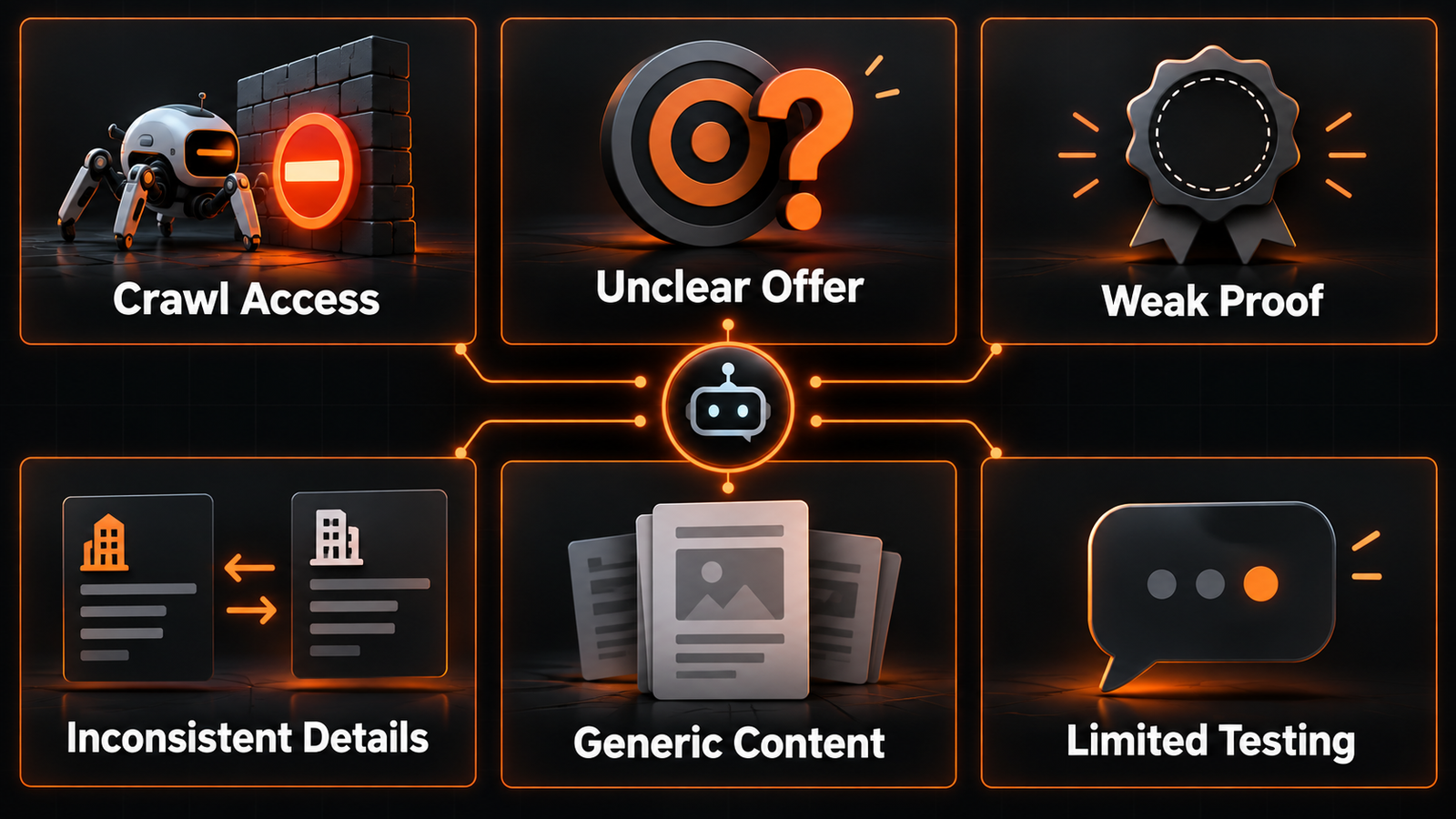
Your brand may be missing because its pages are hard to access, its services are described too vaguely, or there is too little credible evidence about who it helps and what makes it a good fit. Sometimes the brand is visible for one prompt but absent from another because the questions imply different requirements. A single AI response is not a reliable visibility score.
1. Your website may be hard to discover
Before changing your copy, check the basics. Are your key service or product pages public, indexable, and accessible without a login? Are important details written as readable page text rather than buried in an image or behind an interaction? Does your robots.txt block relevant crawlers?
For ChatGPT search, OpenAI says websites should allow OAI-SearchBot to crawl them to be eligible for inclusion in search results. This is a separate setting from GPTBot, which relates to model training. Google says pages offered as supporting links in its AI search features must be indexed and eligible to appear in Search with a snippet. These checks improve eligibility; they do not guarantee a mention.
What to do: Inspect your priority URLs in Google Search Console, review robots.txt and noindex rules, and ask your developer to check whether the site or CDN blocks OAI-SearchBot. Start with the pages that explain your main offers.
2. Your pages say what you do, but not who you are right for
A page that says “we provide quality solutions” gives a recommendation system very little to work with. A buyer might ask, “Which agency can build an ecommerce site for an Indian clothing brand and integrate payments and shipping?” Your website should make it easy to see whether you serve that need.
Add clear details to relevant pages: the service, ideal customer, industries served, location or service area, deliverables, integrations, pricing approach where appropriate, and situations where your offer is a good fit. Use plain language your customers would use. Create separate pages for genuinely different services instead of forcing every offer onto one generic page.
What to do: Compare your main service page with five real recommendation questions from prospects. If a reader cannot answer those questions from the page, improve the page before publishing more general AI-search articles.
3. There is too little evidence to support a recommendation
Recommendations involve judgment. A claim like “best agency” is less useful than a documented project showing the client’s problem, the work completed, and a verifiable outcome. Specific case studies, named expertise, product specifications, policies, customer reviews, and helpful comparisons can give people stronger reasons to choose you. They also make your public information more useful for systems that draw on web sources.
Google’s guidance for its AI search experiences stresses unique, valuable content and cautions against seeking inauthentic mentions. Do not buy generic listicle placements or publish invented testimonials in the hope of forcing an AI recommendation.
What to do: Publish two or three detailed case studies or examples tied to your highest-value services. Explain the starting problem, your approach, the result, and any limits of the result.
4. Other sources describe your brand inconsistently
Your website may say one thing while directory listings, social profiles, business profiles, and older articles say another. A changed company name, outdated category, missing location, or conflicting contact information can make it harder for a customer to verify what you offer. This is especially relevant when a question has local intent.
For local search, Google recommends keeping Business Profile information complete and accurate and managing customer reviews. That guidance is about Google’s local results; it is not a promise that Gemini will recommend a business.
What to do: Review your website, Google Business Profile, major industry profiles, and genuine third-party mentions. Correct outdated descriptions and request honest reviews from actual customers. Keep your core business facts consistent.
5. Your content answers a broad topic instead of the buyer’s decision
A blog post explaining “What is AI SEO?” may help readers learn, but a prompt asking for “an AI SEO agency for a SaaS company with an existing content team” calls for different information. People often ask AI tools questions with budgets, locations, integrations, constraints, and use cases built in.
Create pages that help with those decisions: who a service is for, what the process includes, what it costs or how pricing works, how alternatives compare, and what a buyer should check before choosing. Add concise answers near the relevant details. Avoid producing many thin pages that repeat the same claims with a city or industry swapped out.
What to do: Collect ten actual sales questions and turn the best ones into substantive sections on service pages or dedicated articles. Each should help someone make a better choice, even if they never use an AI tool.
6. You tested one prompt and assumed the result was permanent
AI answers can vary. A recommendation for “best digital marketing agency” may differ from one for “SEO agency for a restaurant in Mohali.” The latter specifies a service, industry, and location. ChatGPT with web search and a chat without current web results can also behave differently. Likewise, a Gemini chat response is not identical to a Google AI Overview result.
Build a small, repeatable prompt set instead of checking your brand name once. Use questions a potential customer would genuinely ask, including alternatives and constraints. Record the date, platform, location if relevant, whether search was used, brands named, links cited, and the quality of the answer. Recheck the same set over time. Treat changes as directional evidence, not a guaranteed ranking report.
| If you find this | Your next step |
|---|---|
| Key page cannot be crawled or indexed | Fix access, indexing, and page availability |
| AI cites your page but does not name your brand | Make the business, offer, and evidence clearer on that page |
| Competitors are named for a specific use case | Build genuinely useful content and proof for that use case |
| Brand appears only when named in the prompt | Improve your category and service information |
| Results change between prompts | Track a consistent set of realistic questions |
A practical 30-day plan
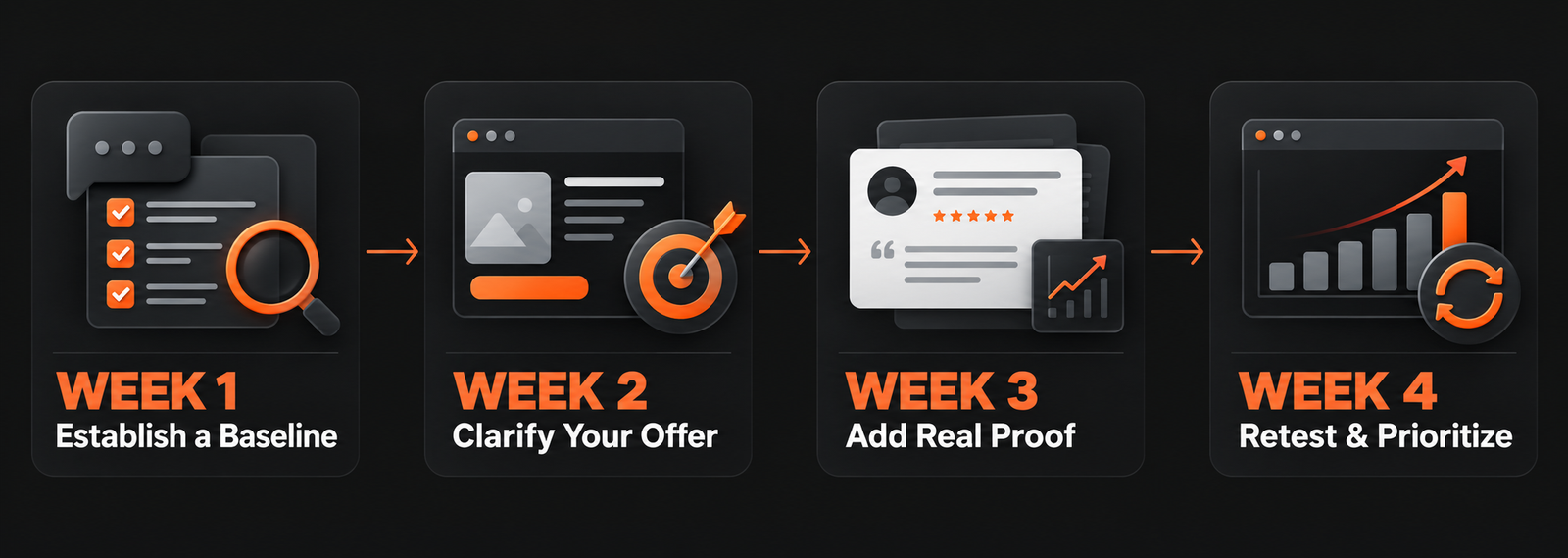
Week 1: Establish a baseline. Choose 10–15 buyer questions, test them across the experiences that matter to your customers, and log mentions and cited sources. Audit crawl access and indexing for your main commercial pages.
Week 2: Clarify your offer. Rewrite weak service or product pages around specific customers, use cases, deliverables, and decision criteria. Add internal links from relevant articles to those pages.
Week 3: Add proof. Publish an original case study, detailed example, or useful comparison. Update legitimate profiles and fix inconsistent company information.
Week 4: Retest and prioritize. Run the same prompts again. Note which sources appear, which pages are missing, and which questions still lack a useful answer on your site. Continue improving the pages with the clearest business value.
Frequently asked questions
Can I pay to make ChatGPT or Gemini recommend my brand?
There is no organic placement purchase that guarantees a recommendation in these answers. Be skeptical of anyone promising a fixed position for your brand in AI responses.
Will adding FAQ schema make my brand appear in AI answers?
No. Structured data should accurately describe visible page content where applicable, but markup alone does not guarantee inclusion. Clear, accessible, useful information is the priority.
Does ranking on Google guarantee a Gemini recommendation?
No. Search visibility can help make information discoverable, but the answer depends on the query and the product experience. Google also states that meeting its requirements does not guarantee a page will be shown.
How long does it take to improve AI visibility?
There is no reliable universal timeline. Technical fixes, page updates, search discovery, and the creation of credible third-party evidence each move at a different pace. Measure progress with a consistent prompt set and normal search metrics rather than promising mentions by a particular date.
The takeaway
If your brand is absent when people ask ChatGPT or Gemini for recommendations, investigate the exact questions first. Then make sure your site can be discovered, your offer is specific, and your claims are backed by useful evidence. That work serves prospective customers as well as AI-assisted discovery.
Find Out Where Your Brand Is Being Missed
Want to identify where your business is being missed? Explore our AI SEO services or contact Designing & Marketing for an audit of your key pages and buyer questions.