If you run a local business, you may have noticed that ChatGPT recommends nearby competitors while skipping yours. You have a verified Google Business Profile, positive reviews, and a website. So why are you missing—and does ChatGPT even use your Google listing?
The short answer
There is no public guarantee that ChatGPT directly reads Google Business Profiles or uses them as a ranking input when it recommends a local business. ChatGPT can search the web, use location to improve local results, and present links from available sources. Those sources and the way a particular answer is assembled can vary. A complete Google Business Profile helps your visibility across Google's own local experiences, but it does not automatically secure a ChatGPT recommendation.
Google's AI experiences need to be separated as well. Google specifically advises businesses to keep their Business Profile details up to date for AI features in Search. That guidance concerns Google's products; it should not be treated as proof of how ChatGPT selects businesses.
ChatGPT, Gemini, and Google AI Overviews are different experiences
It is easy to group every AI answer together, but a local customer may encounter your business in several places:
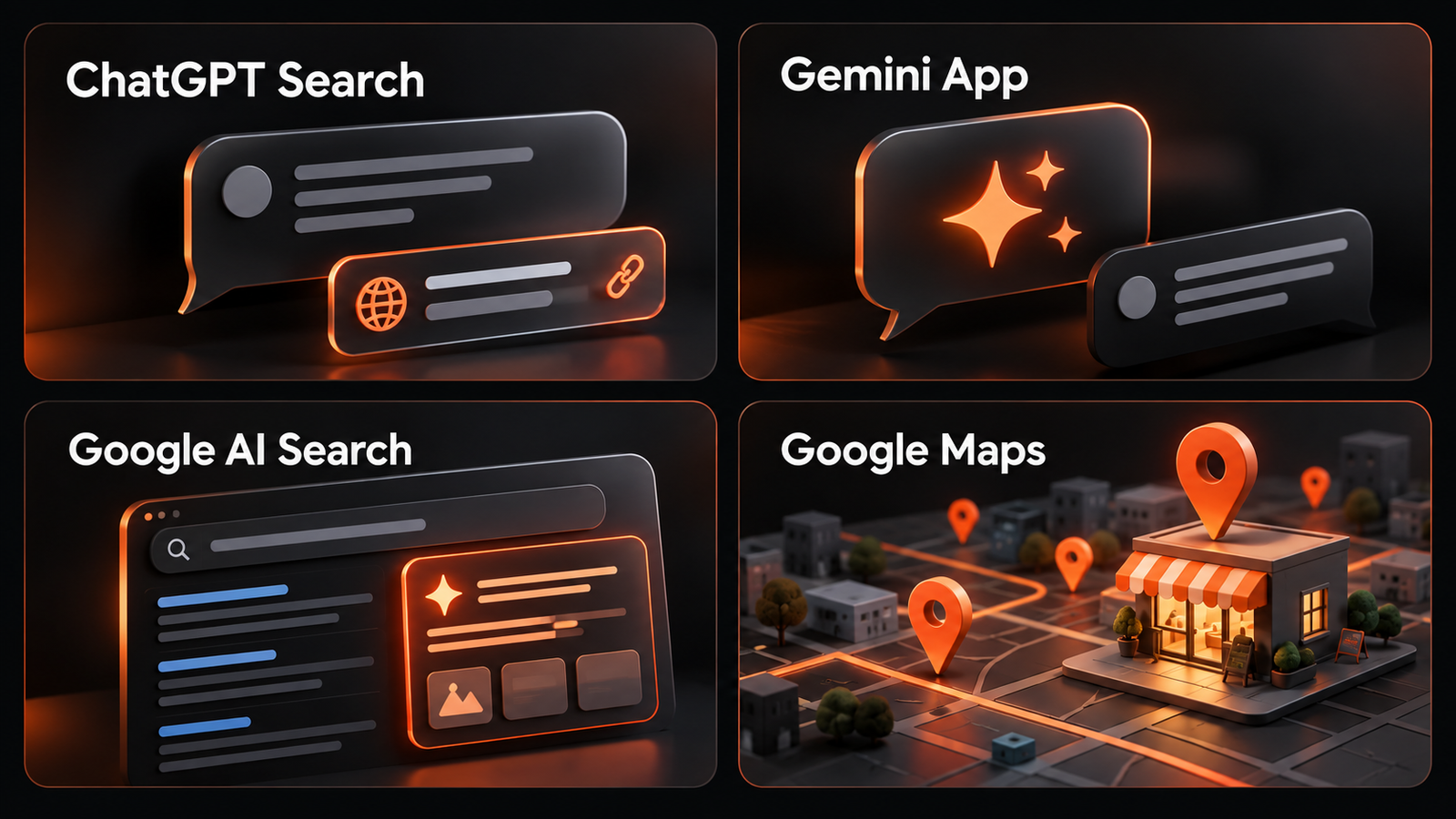
| Experience | What a business owner should know |
|---|---|
| ChatGPT with web search | Can search for current information and use location for local results. A Google listing alone does not guarantee a mention. |
| Gemini app | A conversational Google product. Its answer can depend on the prompt and available connected or search information; do not assume every response follows Google Maps ranking. |
| Google AI Overviews and AI Mode | AI features within Google Search. Google advises keeping Business Profile information current alongside its usual SEO practices. |
| Google Maps and traditional local Search | Business Profile is a direct way to manage key business facts. Local results depend mainly on relevance, distance, and prominence. |
These experiences can return different businesses for the same broad question. Test the specific one your customers use, with a realistic location and service requirement.
Why your Google Business Profile still matters
Your profile helps customers find your address, hours, phone number, services, photos, and reviews in Google Search and Maps. Google also says it compiles business information from your website, licensed sources, users, and business owners. Keeping those details accurate helps customers verify that a recommendation is relevant and that your business is open and available.
For Google local rankings, Google recommends complete and accurate information, relevant categories, current hours, and reviews. Distance and competition also matter. This is useful local marketing work even if a particular ChatGPT answer never references your profile.
Practical check: Search your business name and your main service plus city in Google Search and Maps. Review the category, address or service area, hours, website link, services, photos, and recent reviews. Correct any mismatch with your website.
What ChatGPT may find about your business
When ChatGPT uses search, it can draw on discoverable web information and linked sources. OpenAI says allowing OAI-SearchBot helps a website become eligible for inclusion in ChatGPT search results, although inclusion and placement are not guaranteed. Local answers can also be influenced by the user's location and the question's detail.
This means your own website needs to do more than repeat your company name. A useful local service page should clearly say:
- What you offer and who it is for.
- Which city or service area you genuinely serve.
- What is included, with examples of actual work.
- How a customer can contact or visit you.
- Why a customer might choose you, supported by real evidence.
The same core details should be consistent on legitimate directories and other public profiles. This makes your business easier for people to verify; it is not a technique for forcing an AI recommendation.
Five reasons your business might be absent
1. The question is too broad
“Best marketing agency” could refer to many locations, budgets, and specialties. “Digital marketing agency in Mohali for a restaurant opening its second branch” asks a different question. Test the prompts your buyers would actually use.
2. Your service and location are unclear
A site with one generic services page may not explain why your business fits a specific local request. Give each substantial service a clear page and describe your genuine service area without creating thin pages for every nearby city.
3. Your public details conflict
An old phone number, changed business name, inconsistent hours, or different addresses across platforms can confuse customers and make information harder to trust. Audit the most visible sources and update them.
4. Competitors provide stronger evidence
Relevant reviews, documented projects, detailed menus or service lists, and clear policies help a customer decide. Add authentic proof that answers the buyer's actual concerns. Avoid purchased reviews and fabricated testimonials.
5. You checked one answer and called it a ranking
AI responses can change with wording, location, available search results, and time. One screenshot does not establish a stable position. Track a small set of repeatable local prompts across the experiences that matter to your customers.
A simple local AI visibility checklist
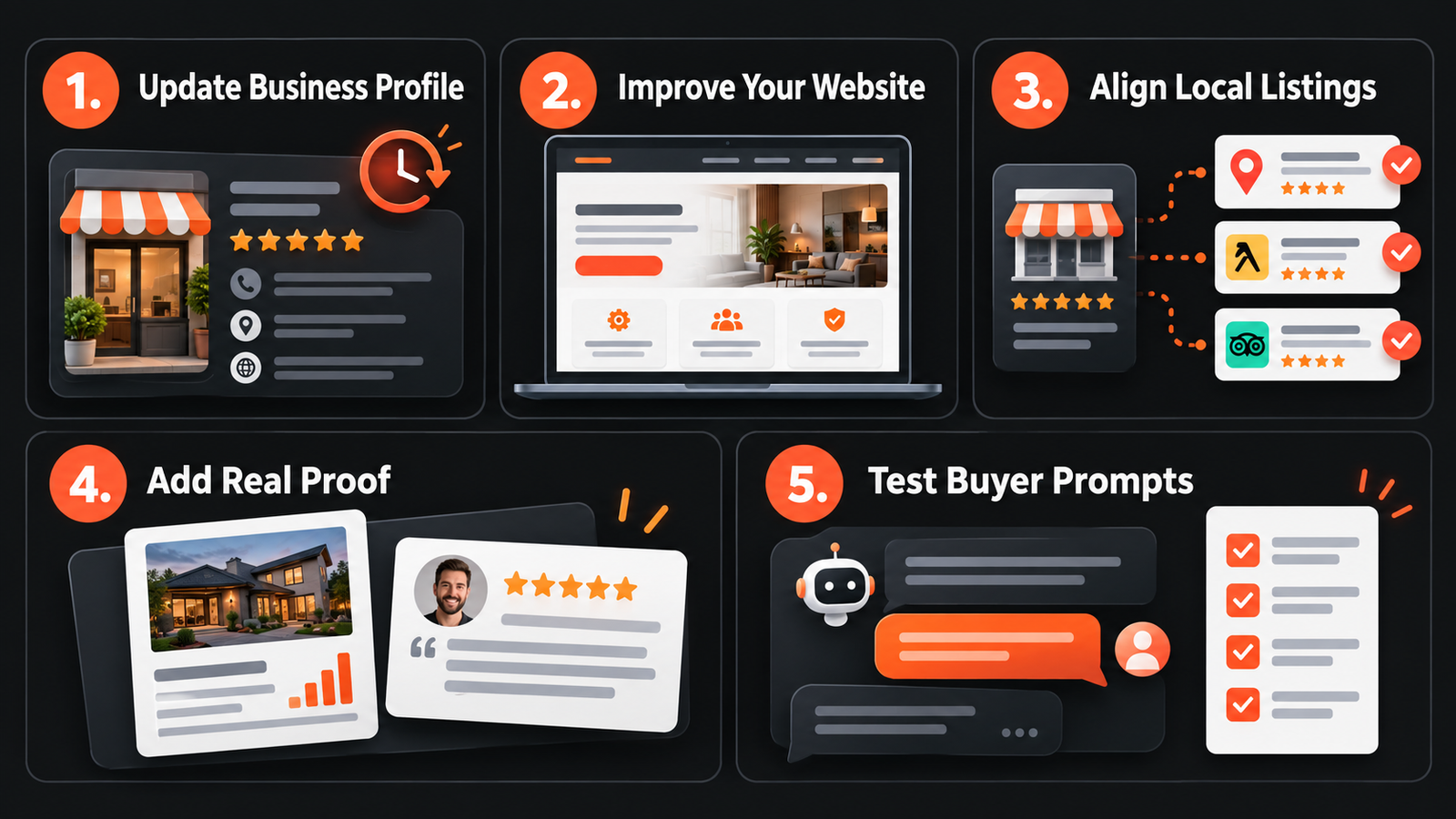
- Fix your Google Business Profile: Verify the main category, contact details, hours, services, and photos. Respond to genuine reviews.
- Improve your website: Publish useful service and location information in crawlable text. Check Google indexing and whether OAI-SearchBot is blocked.
- Align important profiles: Update accurate business details on relevant industry and local directories.
- Add real proof: Publish case studies, project examples, service details, and truthful answers to common buying questions.
- Test buyer prompts: Record which businesses are named, which sources are linked, the date, and the location used. Compare results over time.
Frequently asked questions
If I verify my Google Business Profile, will ChatGPT recommend me?
No guarantee exists. Verification helps you manage how your business appears on Google, but ChatGPT recommendations depend on the question and the information available to that experience.
Does Gemini use Google Business Profile information?
Google connects Business Profile information to its local Search and Maps experiences and recommends keeping it current for AI features in Search. The Gemini app is a separate experience, so avoid assuming every Gemini answer draws from your profile in the same way.
Do Google reviews affect ChatGPT recommendations?
There is no published formula assigning Google reviews a fixed weight in ChatGPT recommendations. Genuine reviews can help customers evaluate a business and improve the quality of public information about it. Do not treat a review count as an AI ranking score.
Should I optimize my Google Business Profile or website first?
Do both in a practical order: correct wrong business details immediately, then improve the service pages that answer your customers' most valuable questions. The profile and website serve different discovery and decision needs.
Final takeaway
A Google Business Profile is important for local visibility on Google, but it is not a switch that turns on ChatGPT recommendations. Keep the profile accurate, make your website specific and accessible, and build credible proof of what your business does. Then test the actual local questions your customers ask across ChatGPT and Google's AI experiences.
Find Out Where Your Local Business Is Being Missed
Explore Designing & Marketing's AI SEO services or contact our team to discuss your local visibility.