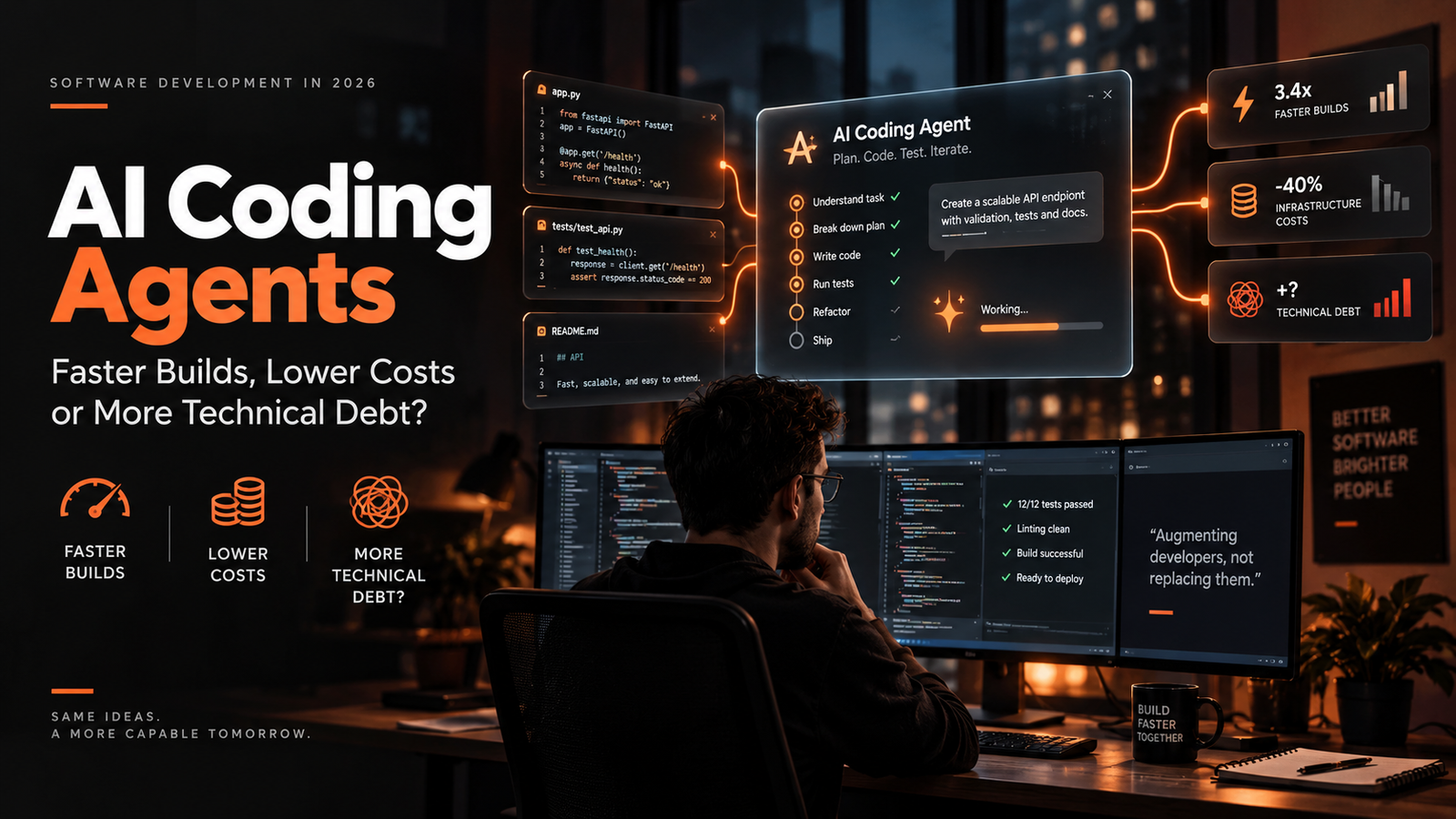
AI coding has moved far beyond autocomplete. Developers are now giving agents entire implementation tasks: inspect the repository, modify several files, run tests, fix failures, refactor code and sometimes prepare a pull request. For businesses, that sounds like a simple promise—build software faster and spend less.
But the real discussion in 2026 is more complicated. AI coding agents can create enormous leverage, yet the hardest software-development problems are shifting from typing code to maintaining product context, architectural consistency, security, validation and long-term ownership.
Quick answer: AI coding agents can reduce implementation time dramatically for the right tasks, but they do not automatically reduce total software cost or eliminate the need for experienced engineers.
The strongest development model is increasingly becoming AI speed + human architecture + code review + testing + security + product ownership.
AI Coding Agents Are Already Becoming Normal Development Tools
This is no longer a niche workflow used only by early adopters. JetBrains' 2026 Developer Ecosystem Survey, covering more than 15,000 professional developers worldwide, reported that 90% were using AI coding agents at work at least weekly during May–July 2026, while 68% were using them daily.
JetBrains also reported that Claude Code had reached 39% professional adoption, Codex 16%, GitHub Copilot 21% and Cursor 12% in that survey period. The numbers change quickly, but the direction is clear: agentic coding is becoming part of mainstream software development.
Survey-based evidence on weekly and daily AI coding-agent usage among professional developers.
What Is an AI Coding Agent?
An AI coding assistant usually helps a developer while the developer remains in direct control of each step. An AI coding agent goes further: it can inspect a codebase, reason about a task, make edits across multiple files, execute tools or tests, observe failures and continue working toward an outcome.
| Traditional AI Assistant | AI Coding Agent |
|---|---|
| Suggests code while you type | Can take a multi-step implementation task |
| Usually works on the current file or prompt | Can navigate a repository and multiple files |
| Developer drives most actions | Agent can plan and execute a sequence of actions |
| Often focused on code generation | Can include coding, testing, debugging and review |
| Short interaction loops | Potentially longer semi-autonomous workflows |
Gartner describes this broader market shift as a move from AI-assisted development toward agentic software development spanning planning, code creation and review across the software development lifecycle.
Industry perspective on the shift from AI-assisted development toward broader agentic software-development workflows.
Why Businesses Are Excited About AI Coding Agents
Faster Prototyping
Teams can turn product ideas into testable prototypes much faster when agents handle repetitive implementation work.
More Output per Engineer
Experienced developers can delegate boilerplate, tests, refactoring and routine changes while focusing on higher-value decisions.
Faster Bug Investigation
Agents can inspect logs, search a repository, trace code paths and propose fixes without manually opening every file.
Legacy Code Assistance
An agent can help explain unfamiliar code, prepare migrations and identify where changes may need to be made.
Testing & Documentation
Generating test cases, documentation and repetitive support code can become much quicker.
Smaller Teams Can Attempt More
A capable engineering team can potentially handle a broader scope without increasing headcount at the same rate.
How Much Code Are Developers Actually Letting Agents Write?
JetBrains' August 2026 analysis provides an important reality check. Based on self-reported data from more than 15,000 professional developers, the survey estimated that roughly 47% of code produced for work was fully generated by agents on average, while about 38% involved some AI assistance.
At the same time, only around 22% of developers reported that more than 80% of their code was agent-generated. In other words, fully agentic coding is real, but it is not yet the universal workflow.
Important: “Percentage of code generated” is not the same thing as “percentage of software development delegated.” Architecture, requirements, debugging, validation, operations and product decisions still exist even when an agent writes much of the implementation.
Evidence used for the section comparing fully agent-generated code with partially AI-assisted development.
What Developers Are Actually Saying on Reddit
Industry surveys show adoption. Reddit discussions are useful as community experience—not as formal evidence—because they reveal the day-to-day problems developers say they encounter after using agents on real projects.
“Something that might have taken me a week before can sometimes be built in a day.”
“The agent understanding the codebase but not why something was built a certain way.”
“AI confidently changing something that technically makes sense but is completely wrong for the product.”
Community anecdote; individual experiences may vary.
Community anecdote; individual experiences may vary.
Takeaway: The implementation becomes faster, but product memory, historical decisions and intent become the new bottlenecks.
The Hidden Problem: Agents Can Understand Code Without Understanding the Product
A repository contains code, tests and documentation. But many important product decisions live outside the repository: why a workflow was designed a certain way, which customer complained about an earlier implementation, which integration has undocumented edge cases, or why a seemingly inefficient rule exists for regulatory or business reasons.
An agent may produce technically valid code while still violating that context.
Code Context
What files, functions, APIs and dependencies currently exist?
Product Context
Why does the feature behave this way and what does the customer actually need?
Business Context
Which risks, deadlines, contracts and operational constraints affect the decision?
AI Coding Makes Development Faster. Does It Also Create Technical Debt Faster?
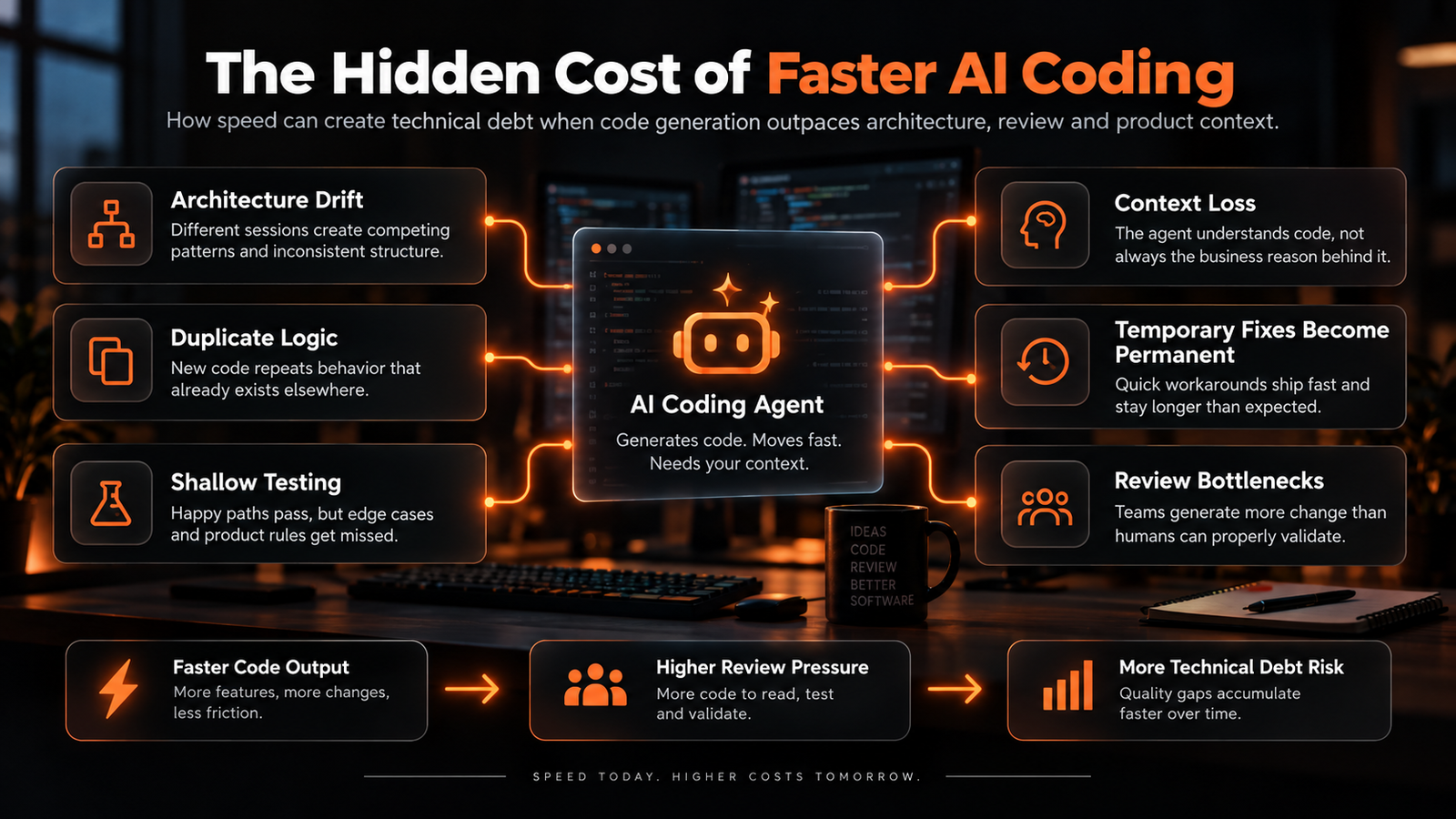
Technical debt is not simply bad code. It is the future cost created by design decisions, shortcuts, duplication, weak abstractions, missing tests or unclear system boundaries.
When an agent can generate hundreds of lines of code quickly, teams can accumulate both useful implementation and architectural inconsistency at a much higher rate.
Agentic technical debt can appear when:
- Different agent sessions make different architectural assumptions.
- A new implementation duplicates logic that already exists elsewhere.
- Tests validate the happy path but miss product-specific edge cases.
- Temporary workarounds become permanent because they ship quickly.
- Generated code solves the immediate ticket but weakens the overall design.
- Developers approve large diffs without fully understanding them.
This does not mean agent-generated code is inherently lower quality. It means faster code production requires stronger review and architectural discipline, not weaker discipline.
Can AI Coding Agents Actually Reduce Software Development Cost?
Sometimes yes—but “faster coding” and “lower total software cost” are not the same metric.
| Potential Cost Reduction | Potential New Cost |
|---|---|
| Less time spent on boilerplate | Agent subscriptions and token usage |
| Faster prototype development | Extra review of large generated diffs |
| Faster test generation | Incorrect or shallow tests that need rework |
| Quicker repository exploration | Context-management and documentation work |
| More output per engineer | More changes entering the system simultaneously |
| Faster maintenance tasks | Potential future technical debt |
Industry reporting in 2026 showed a similar pattern: developers were adopting AI quickly, while organizations were still working out how to translate individual productivity gains into measurable improvements in delivery speed, reliability and cost efficiency.
Business takeaway: Measure AI development ROI at the product level—time to release, defect rate, support burden, infrastructure cost and engineer throughput—not only by how quickly code was generated.
AI Tool Costs Can Grow Faster Than Teams Expect
Agentic development can consume much more model usage than autocomplete because the agent repeatedly reads files, reasons over context, executes tasks, reviews results and may run several attempts before reaching an acceptable solution.
As teams begin running multiple agents or longer autonomous tasks, model usage, governance and cost visibility become part of engineering management—not just developer tooling.
What About Security?
AI-generated code should be treated like code produced by any other contributor: it needs review, testing and security validation before production.
- The agent may use an unsafe dependency or outdated implementation pattern.
- Authentication and authorization logic can look correct while missing an edge case.
- Secrets or sensitive data can be exposed through poor tool configuration.
- Generated SQL, shell commands or infrastructure changes can have destructive consequences.
- An agent may broaden access while trying to make a failing integration work.
- Code can pass tests while violating security requirements that were never included in the prompt.
Anthropic's 2026 software-development trends report makes a similar point from the vendor side: agent autonomy still depends on supervision, validation and human judgment. Anthropic says developers report using AI in roughly 60% of their work while being able to fully delegate only a much smaller share of tasks.
Supports the point that greater agent autonomy still depends on supervision, validation and human judgment.
Why Code Review Matters More When AI Writes More Code
Historically, code-writing speed naturally limited how much change could enter a codebase. AI removes part of that constraint. One developer can now produce or request far larger changes in a short time.
The bottleneck therefore moves downstream: review, validation, testing and integration.
Review the Intent
Does the change solve the actual business requirement, not just the textual ticket?
Review the Architecture
Does it follow existing patterns or create another competing abstraction?
Review Failure Modes
What happens with invalid data, timeouts, retries, permissions and partial failure?
Review Maintainability
Will the next engineer understand why this implementation exists six months later?
Can Smaller Teams Build Bigger Products?
AI coding agents can increase the scope a small experienced team can handle, especially when the product has clear requirements and strong architecture.
But this does not mean a two-person team automatically becomes equivalent to a twenty-person engineering organization. Large products require more than coding: product management, design, security, quality assurance, infrastructure, support, compliance and operational ownership all remain.
Better framing: AI can reduce the amount of human effort required for some implementation work. It does not remove the need to own the consequences of the software.
Are AI Coding Agents Replacing Experienced Developers?
A more useful question is: what work becomes more valuable when agents handle more implementation?
Experienced engineers can increasingly spend less time writing repetitive code and more time on architecture, trade-offs, debugging, security, system boundaries and product decisions. That makes judgment—not typing speed—more important.
“Using tools like Claude is in most places nowadays ‘normal’, it is like putting ‘knows how to use vscode’ in the JD.”
Takeaway: AI-tool usage may increasingly become an expected working skill rather than a separate job category.
Where AI Coding Agents Work Really Well
Well-Scoped Features
Tasks with clear acceptance criteria and an existing architecture.
Test Generation
Adding coverage around known behaviours and edge cases.
Refactoring
Mechanical changes where expected behaviour is already protected by tests.
Bug Investigation
Searching code paths, logs and related files to narrow down causes.
Documentation
Explaining modules, APIs and implementation details for developer use.
Migration Assistance
Updating libraries, APIs or repetitive syntax across a codebase.
Where Humans Are Still Essential
- Turning ambiguous business requirements into precise product behaviour.
- Choosing architecture and making long-term technical trade-offs.
- Deciding which risks are acceptable for the business.
- Reviewing authentication, authorization and sensitive data handling.
- Handling production incidents where incomplete information must be interpreted.
- Understanding customers, workflows and organizational constraints.
- Taking responsibility for whether the software should ship.
A Practical AI + Human Software Development Workflow
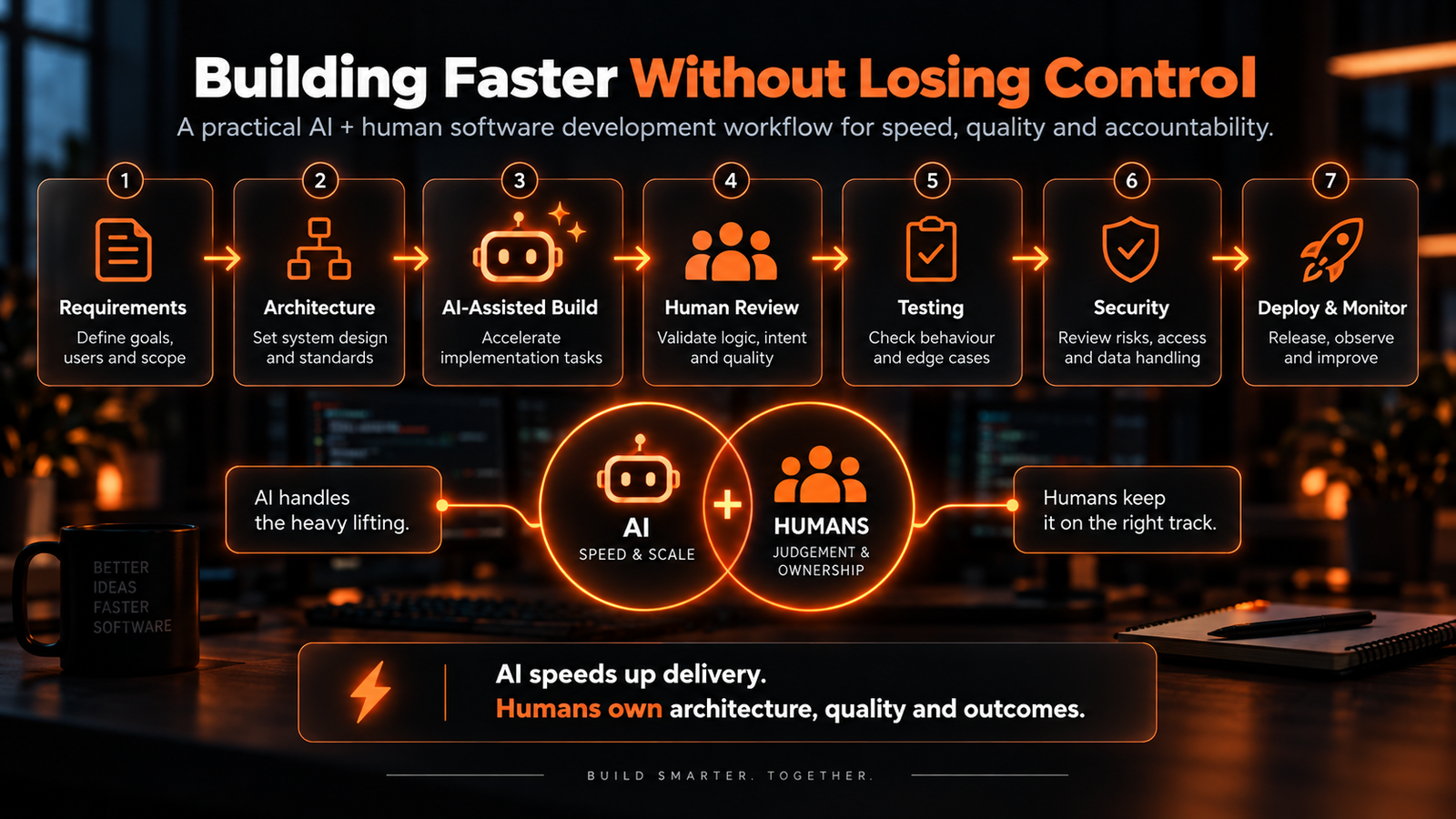
1. Start With Requirements, Not the Prompt
Define expected behaviour, constraints, users, data and acceptance criteria before sending work to an agent. A precise implementation prompt cannot compensate for an unclear product decision.
2. Establish the Architecture
Decide system boundaries, database responsibilities, APIs, security rules and coding conventions. Agents should work within an architecture instead of inventing a new architecture for every task.
3. Delegate Bounded Implementation
Give the agent a clear task with access only to the context and tools it genuinely needs. Smaller, verifiable units are easier to review than one enormous autonomous change.
4. Review the Diff and the Intent
A human engineer should validate not only whether the code compiles, but whether it fits the product, architecture and security model.
5. Test Beyond the Happy Path
Automated tests, integration tests and manual validation should include failures, retries, permissions, invalid data and edge conditions.
6. Treat Security as a Separate Gate
Sensitive code paths should receive explicit security review. “The agent wrote tests” is not a substitute for threat-aware validation.
7. Monitor Production
Deployment is not the end of the task. Error rates, latency, infrastructure usage and customer behaviour determine whether the implementation actually works in reality.
Should a Business Choose an Agency That Uses AI Coding Agents?
The useful question is not whether an agency uses AI. Most modern development teams increasingly will. The more important questions are who defines the architecture, who reviews the AI-generated code, how tests and security are handled, who owns production problems, and whether the team can explain why a technical decision was made.
For customers, the outcome matters more than the tool. A business needs reliable software that solves the right problem, can be maintained and can continue evolving after launch.
How Designing & Marketing IT Solutions Approaches AI-Assisted Development
With 10+ years of experience across web, mobile and software development, Designing & Marketing IT Solutions can use modern AI development workflows where they improve delivery—but the project still requires human responsibility for architecture, implementation decisions, review, testing and long-term maintainability.
Technology Planning
Choose an architecture and stack based on product requirements rather than tool hype.
AI-Assisted Implementation
Use AI where it can speed up well-defined development work.
Human Code Review
Review implementation quality, architecture fit and product intent before release.
Testing & QA
Validate expected behaviour, integrations and important edge cases.
Security Considerations
Review sensitive data flows, permissions and security-critical components.
Maintenance & Ownership
Keep the system understandable and supportable after the initial development sprint.
Need to Build Software Faster Without Losing Control of Quality?
AI can accelerate development, but the right architecture, review process and engineering ownership still determine whether the product succeeds. Talk to Designing & Marketing IT Solutions about your web, mobile, SaaS or custom software project.
Discuss Your Software ProjectFrequently Asked Questions
What is an AI coding agent?
An AI coding agent is a development tool that can perform multi-step software tasks such as inspecting a repository, modifying code, running tests, debugging failures and continuing toward a defined outcome.
Can AI coding agents build complete software products?
They can complete substantial implementation work, but production software still requires requirements, architecture, validation, testing, security, deployment and ongoing ownership. The amount that can safely be delegated depends on the project.
Do AI coding agents reduce software development costs?
They can reduce time spent on some development tasks, but total cost also includes review, testing, model usage, infrastructure, maintenance and possible rework. Businesses should measure overall delivery outcomes rather than code-generation speed alone.
Can AI coding agents create technical debt?
Yes, especially when generated changes are accepted without architectural review. Agents can also help reduce technical debt through refactoring and testing when they are used within a well-governed engineering process.
Is AI-generated code secure?
AI-generated code should not be assumed to be secure. Security depends on the implementation, dependencies, architecture, configuration and review process. Security-critical changes should be explicitly validated.
Will AI replace software developers?
AI is automating more implementation work, but software development also includes architecture, product understanding, debugging, security, trade-offs and responsibility for production outcomes. Those areas continue to require human judgment.
Which AI coding tools are popular in 2026?
Professional developers are using tools such as Claude Code, OpenAI Codex, GitHub Copilot, Cursor, OpenCode and other coding agents. Adoption changes rapidly, so tool choice should depend on workflow, codebase, governance and cost rather than popularity alone.
Should businesses allow AI agents to modify production code?
Businesses should establish controls around repository access, testing, review, secrets, permissions and deployment. Higher-risk systems generally require stricter human review and approval before AI-generated changes reach production.
What is the best way to use AI in a software development agency?
A practical model is to use AI to accelerate well-defined implementation work while humans remain responsible for requirements, architecture, review, testing, security, deployment and client outcomes.